
Your knee swelled up within minutes. You heard something. Now you are sitting on the bench or the sideline wondering whether your season is over.
That moment of panic is normal. What you do in the next two weeks, however, is not something to leave to guesswork.
Most athletes immediately fixate on surgery timelines and MRI results. Those questions matter, but they are not what determines how well the first phase of recovery goes. What matters right now is simpler and more immediate: can you walk without a limp? Can you fully straighten the knee? Is swelling going up or down? Is your quad firing?
Get those four things right in the first two weeks, and every later milestone in recovery becomes easier to reach. This guide explains how — based on the same evidence-based framework used at Sather Reid’s Acute Knee Injury Clinic (AKIC) in Edmonton and St. Albert, and informed by current consensus guidelines on early ACL management.
Here is what this guide covers:
- Why gait protection, full extension, and swelling control come before strengthening
- How to know whether your activity level is too aggressive
- What early exercises actually belong in this phase
- When to get assessed promptly at the AKIC in Edmonton or St. Albert
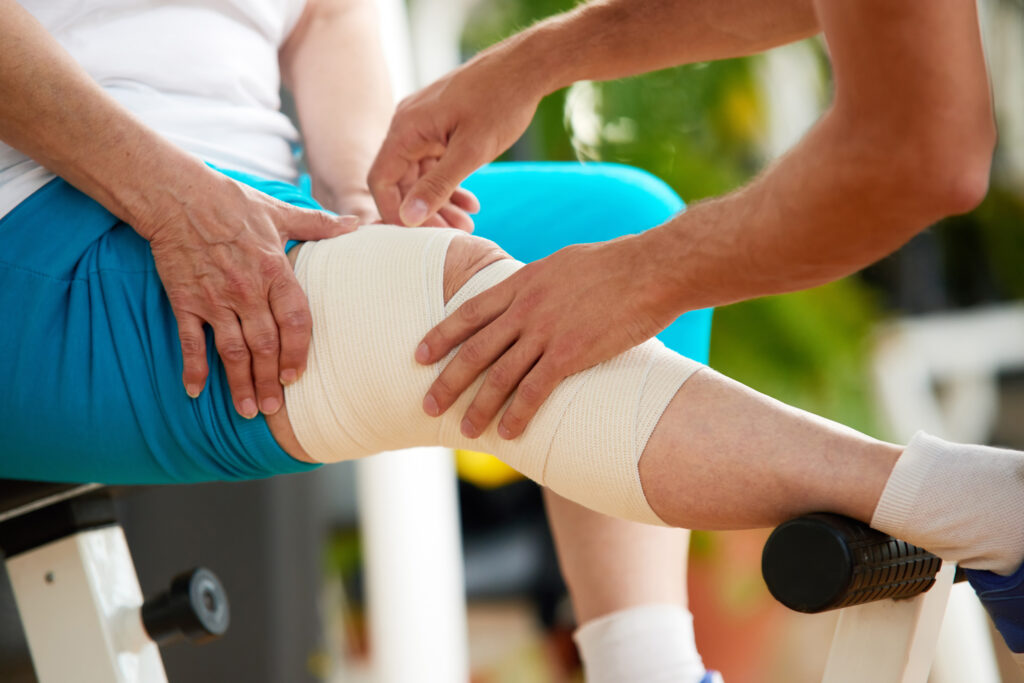
What the First 2 Weeks Are Actually Trying to Accomplish
The instinct after an injury is to do more: stretch harder, load heavier, get back on the ice or the pitch faster. Resist it.
The first two weeks have four specific goals. Progress depends on how well you achieve them, not on what day of recovery you are on:
- Reduce swelling. Joint effusion directly inhibits your quadriceps and alters how your entire lower limb moves. Getting it under control is not cosmetic — it is functional.
- Restore full active range of motion, especially extension. You need a straight knee to walk normally. Even a small loss of extension disrupts gait mechanics and keeps the knee irritated.
- Normalize walking. A limp is not just uncomfortable — it reinforces faulty movement patterns that travel up through the hip and core and down through the foot and ankle.
- Reactivate the quadriceps. After an ACL injury, the quad often shuts down. Getting it firing again is one of the earliest and most important milestones in the entire recovery.
Key point: This phase is criteria-based, not calendar-based. Progress is measured by swelling response, movement quality, and quad control — not by whether it is day 4 or day 10. Athletes who manage this phase well consistently reach later rehab milestones faster than those who push too hard too early.
One practical rule to anchor everything that follows: if swelling increases after an activity and has not settled by the next morning, that activity was too much.
Use Crutches or a Gait Aid Until Walking Is Normal
Crutches are not a sign that things went badly. They are a tool to protect your movement quality while your knee is swollen, painful, and unable to support full weight without compensation.
The goal is not to get off crutches by a specific day. The goal is to stop using them when walking is genuinely normal: controlled weight bearing, no visible limp, and no extension lag during your stride.
Keep using crutches if:
- Your knee is significantly swollen and bearing weight causes a visible limp
- You cannot fully straighten the knee during the stance phase of walking
- Pain is causing you to shift weight away from the injured leg
- Your quad is not activating adequately to support the knee
- Your physiotherapist has recommended them based on your assessment findings
You may be ready to wean off crutches when:
- You can walk with a normal, symmetrical stride pattern
- You have a strong and consistent quad contraction
- You can fully extend the knee during walking without a lag, and have approximately 120 degrees of flexion
- Swelling is controlled and not increasing with activity
- Your physiotherapist has confirmed your gait is safe to progress
Your physiotherapist at the AKIC will assess your walking pattern directly and guide this transition based on what they see — not based on a fixed number of days.
Get Full Knee Extension Back Early — Walking Depends on It
Most athletes assume that bending the knee is the hard part of ACL recovery. In the first two weeks, the opposite is true. Full extension is the priority — and losing even a few degrees of it sets off a chain reaction most athletes never anticipate.
Why a small extension deficit causes a big problem
Your knee needs to straighten fully during every step you take. When it cannot, your pelvis hikes to clear the leg, your hip overloads, and weight shifts to the opposite side. That compensation becomes a movement habit within days. The quad, which depends on a straight knee to generate force, stays inhibited. The swelling, which the nervous system reads as a threat and uses to further suppress the quad, stays elevated.
One small extension deficit quietly undermines gait, quad activation, and swelling control all at once. According to Filbay and Grindem’s evidence-based ACL management recommendations, treatments targeting full passive extension and quadriceps function should begin on the first day after ACL rupture — not after swelling settles, not after imaging, from day one.
Clinical note: Extension loss is one of the most common and preventable complications in early ACL recovery. Addressing it early is far easier than trying to regain it weeks later when stiffness has set in.
ROM priorities in the first 2 weeks
- Extension first. Work toward matching the uninjured side. Even 5 degrees of deficit matters.
- Frequent, low-load ROM work. Short sessions multiple times per day are more effective than one long push.
- Ice massage before ROM work. Cold application has been shown to decrease pain messages to your brain and allows the muscle and joint to achieve more range of motion.
- Avoid forcing flexion before extension is restored. Pushing bend before the knee straightens fully can increase irritation and swelling.
- Prone hangs and heel props are simple, effective ways to encourage passive extension at home.
- Stationary biking (once tolerated) helps restore both extension and flexion through a controlled, non-impact arc of motion.
If Swelling Goes Up, Your Program Is Too Aggressive
Swelling is not just a symptom to manage around — it is a direct signal about load tolerance, and it has a measurable effect on quad function. Joint effusion triggers arthrogenic muscle inhibition: the nervous system reads excess fluid in the joint as a threat and dials down quad activation in response. More swelling means less quad, which means worse gait and slower progress.
The practical rule is straightforward: if swelling increases after an activity and has not settled by the next morning, that activity was too much.
Swelling response framework
| Response | What it means | What to do |
| Green: Swelling stable or reduced by next morning | Load was appropriate | Continue current activity level |
| Yellow: Mild increase that settles within 24 hours | Load was at the edge of tolerance | Reduce intensity or duration slightly; monitor closely |
| Red: Persistent increase, worse extension, more limp, less quad control | Load was too aggressive | Reduce activity significantly; prioritize ice, elevation, and rest before progressing again |
Practical swelling management
- Elevate the leg above heart level when resting, especially in the first few days
- Before a long car ride, flight, or extended sitting period (school, work, travel), plan a short walk break every 45 to 60 minutes to prevent stiffness and fluid pooling
- Compression can help during activity
- Avoid prolonged standing or sitting with the knee dependent in the first week
According to the University of Delaware’s ACL rehabilitation clinical data summary, exercise progression should be guided by soreness and effusion response — not by session effort alone. A session that feels easy but spikes swelling is a session that was too much.
Quadriceps Activation: One of the Biggest Early Milestones
Once swelling is controlled and extension is improving, the next priority is re-establishing the neural connection between your brain and your quad. The arthrogenic inhibition covered above is the reason this connection breaks down — the swelling section explains the mechanism. Here, the focus is on what to do about it.
The Aspetar clinical practice guideline on ACL rehabilitation confirms that isometric quadriceps exercises and straight leg raises are safe to prescribe in the first two weeks and can support faster ROM recovery when started early. High-frequency, low-load work is the approach — short sessions repeated throughout the day rather than one long effort.
The first clinical target: A visible, repeatable quad contraction and a straight leg raise without any extension lag. Not heavy loading. Not single-leg work. Just a reliable contraction.
Early quad activation checkpoints
- Quad set: Tighten the quad with the leg straight and hold for 5 to 10 seconds. You should see and feel the muscle engage. If you cannot feel it fire, focus here before progressing.
- Straight leg raise without lag: Lift the straight leg to about 45 degrees with no bend at the knee during the lift. A lag (the knee bending as you raise) means the quad is not activating adequately yet.
- Terminal knee extension: Standing with a resistance band, focus on the last few degrees of straightening. This trains the quad at the range it needs most for walking.
- Frequency over intensity: Short quad activation sessions multiple times per day are more effective early on than one longer session. The nervous system responds to repetition.
Early Cardio and Whole-Leg Strength Still Belong in This Phase
An ACL injury does not mean two weeks of complete rest. It means two weeks of the right kind of movement. The Edmonton Bone and Joint Centre’s ACL rehabilitation protocol includes low-impact cardio and early strengthening as stage 1 goals — alongside swelling control, ROM work, and gait normalization.
The key is choosing activities that support recovery rather than spike symptoms.
Why foot, ankle, hip, and core matter right now
The knee does not operate in isolation. Weakness at the hip and core changes how load is distributed through the knee on every step. Stiffness or weakness at the foot and ankle alters the forces travelling up through the lower leg. Addressing these areas early does two things: it supports better knee mechanics immediately, and it builds the foundation for the strength work that comes later in rehab.
Return to play starts now — not when you are cleared to run. Every glute bridge, every calf raise, every core activation session is a deposit into the account you will draw from when it is time to sprint, cut, and compete again.
Your Progress Markers
Use these criteria to gauge whether you are on track. Progress is judged by movement quality and symptom response, not by how hard a session felt.R
| Marker | On track | Not yet |
| Gait | Walking normally without crutches, or close to it | Still requiring crutches for all walking |
| Extension | Full or near-full, matching the other side | Persistent deficit of more than 5 degrees |
| Flexion | Approaching 120 degrees | Limited to 90 degrees or less |
| Swelling | Trace or none after activity | Consistently elevated after light activity |
| Quad | Clean straight leg raise without lag | Lag still present |
| Cardio | Tolerating stationary bike or pool work | Cannot yet tolerate low-impact activity |
When to Get Assessed Quickly in Edmonton or St. Albert
This guide is designed for athletes who have already been assessed by a Sport Medicine Physician and Physiotherapist. If you have not yet been assessed — or if you are unsure whether what you experienced was an ACL injury — early expert evaluation is the most important step you can take.
Seek prompt assessment if you experienced any of the following:
- A pop at the time of injury
- Rapid swelling within the first few hours
- Inability to fully straighten the knee
- A feeling of instability or giving way when walking
- Significant difficulty bearing weight
Early assessment through the Acute Knee Injury Clinic (AKIC) at Sather Reid Sport Medicine in Edmonton and St. Albert provides coordinated evaluation by a Sport Medicine Physician and Physiotherapist, imaging arranged when appropriate, and referral to an orthopaedic knee surgeon if needed. The goal is not just to confirm the diagnosis — it is to give you a clear, individualized plan for the early phase so you are not guessing through the highest-risk weeks of recovery.
Do the Simple Things Early, and Do Them Well
The first two weeks after an ACL injury are not about proving toughness. They are about setting the knee up for everything that follows.
The markers that matter most in this phase are not dramatic:
- Swelling is going down, not up
- Extension is improving toward full
- Walking looks normal, or close to it
- The quad is activating reliably
Get those right, and the later phases of rehab — the strength work, the running, the return to sport — start from a far better position. Current consensus in ACL rehabilitation is clear: criteria-based progression outperforms time-based progression at every stage. The athletes who do the simple things well in week 1 and week 2 consistently reach return-to-play milestones faster than those who push too hard too early.
If you are in Edmonton or St. Albert and need expert guidance through this phase, book an assessment at the Acute Knee Injury Clinic.